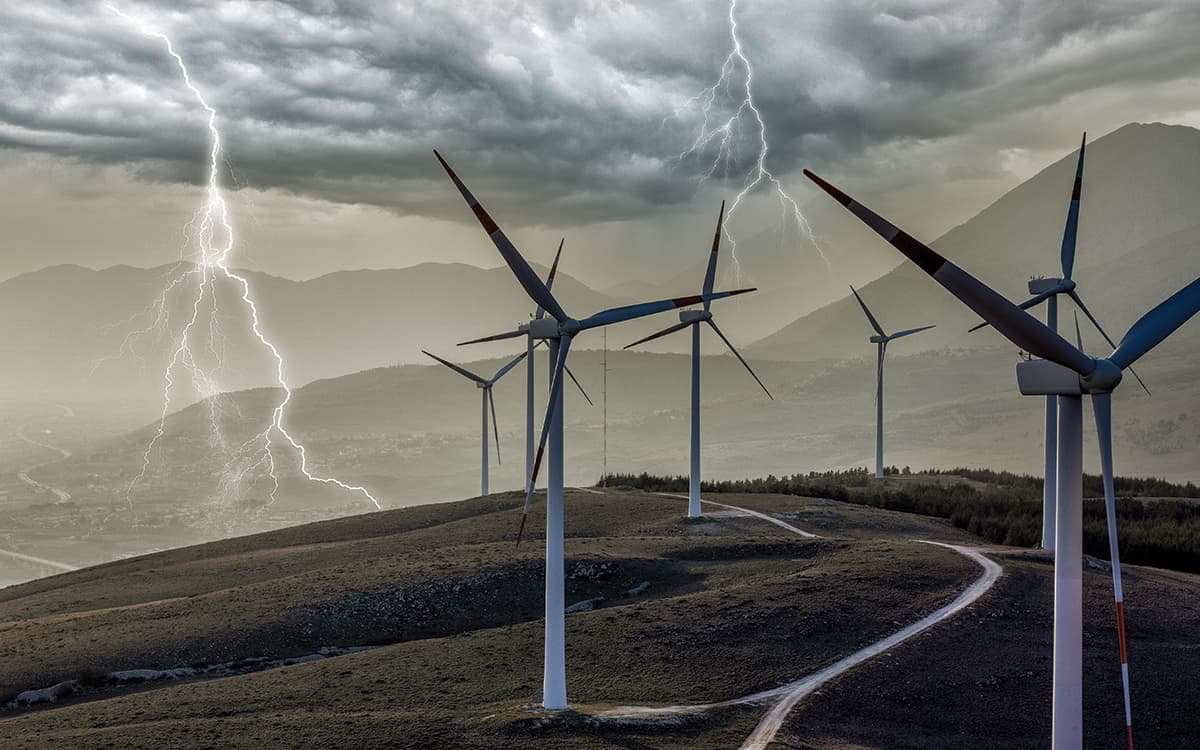
Lightning protection studies of UK renewable energy systems
The UK government has set targets to reach net zero by 2050, with a strategy for all electricity to be supplied by 100% zero-carbon generation by...
Lightning strikes can be highly destructive, having the potential to cause loss or disruption of services (such as utilities), irreparable damage to buildings, economic or monetary loss to infrastructure, and even cause injury or loss of life to people or livestock. Our specialists at PSC UK apply over 15 years’ worth of industry experience to support our clients in determining the risks associated with lightning to their assets and, where required, provide recommendations and designs for the mitigation of these risks in compliance with industry standards.
Our consultants are highly experienced, offering unbiased and impartial lightning risk assessment and design studies ensuring compliance with UK and international standards, which are independent of installation services or material sales.

Risk assessment of buildings and infrastructure in accordance with IEC (BS) EN62305-2
Lightning Protection System (LPS) modeling and analysis (under simulated lightning strikes) using 3D modeling software
LPS design in accordance with IEC (BS) EN62305-2, NFPA780 and IEEE998
Preparation of LPS designs using Computer Aided Design (CAD) software
Electrical system protection guidance
Post-construction commissioning assessment
Third-party LPS design audits
Lightning protection policy support
Insulation coordination studies including switching and lightning surge analysis
![]()
Vendor-neutral and independent technical consultancy

![]()
Expert knowledge of international lightning protection policies and specifications for a range of assets and installations

![]()
Over a decade of successful lightning protection project delivery experience

![]()
Highly experienced team of innovative and creative thinkers focused on developing solutions to complex problems
A 330/33 kV Gas Insulated Substation (GIS) with a four-breaker mesh arrangement was being established for connection to a large power generating plant. The substation was designed to connect to an existing 330 kV overhead transmission line and to connect two 330/33 kV transformers. As part of the work, PSC were requested to conduct an insulation coordination study to confirm that the selected types and locations of the surge arresters are suitable to provide adequate protection level for substation equipment against switching and lightning over-voltages.
PSC were appointed to undertake a lightning protection study for the 38kV AIS substation and associated wind turbines, in accordance with IEEE80, IEEE81 and ESBN specifications 18134 and 18133. As part of the study, a buried earth electrode system for each wind turbine was designed to ensure that lightning protection resistance requirements were achieved. CDEGS earth fault simulation studies were carried out to determine the resistance of the proposed earthing system for each wind turbine to ensure compliance was met.
As part of the commissioning of a 220kV underground cable and GIS switchgear in Auckland, New Zealand, PSC studied the effects of lightning and switching surges as well as over-voltages associated with back feed from a weak distribution network. As a result of our studies, the client modified the scheme design and installed a shunt reactor to mitigate over-voltages.
PSC were subcontracted to carry out an insulation coordination study to demonstrate that the location, type and ratings of proposed surge arresters were adequate to protect the wind farm electrical system from potentially damaging over-voltages. As part of the work, PSC conducted the insulation coordination study utilizing EMTP software to investigate potential over-voltages on the wind farm electrical system. These included both lightning and switching over-voltages associated with the connection to the local 66 kV distribution network and also switching over-voltages generated internally within the Goole Fields II 33 kV collection network.
The UK government has set targets to reach net zero by 2050, with a strategy for all electricity to be supplied by 100% zero-carbon generation by...